
Nobody reviewed this page. There’s no doctor’s photo at the top, no white coat, no badge. What you get instead is a citation under every claim that matters, so you can click through and check it yourself. That’s the deal. Let’s get into it.
Here’s the thing that trips people up before they’ve even started shopping: MOTS-c has, as of right now, essentially zero completed human trials of the actual peptide. Not “a few small ones.” Zero. The nearest thing we have to a human study is a lab-made cousin of MOTS-c, called CB4211, tested in 20 people [M5]. Twenty. That’s the whole human file for this molecule, more or less.
So when a company promises you a “reputable” source of MOTS-c, ask yourself: reputable at what? Nobody can prove it works especially well in a person, because that trial hasn’t been run. So “reputable” can’t mean “best results.” It has to mean something you can actually check with your own eyes: is a licensed clinician involved, does a real pharmacy handle it, is the company being straight with you about the evidence, and is anyone answerable if it goes wrong. Those you can measure. A low price per milligram tells you none of that.
One more thing before we go further: nothing on this page is for sale, and nothing here links to a shopping cart. Every link goes to the actual research.
The one-phrase test that clears up 90% of the confusion
Here’s the shortcut I wish someone had handed me first. Look for these words on the product page: “research use only” or “not for human consumption.” If you see them, the seller has just told you, in writing, that this isn’t meant to go in your body, and that they’re operating outside medical regulation on purpose. It’s not fine print you can skim past. It’s the whole story, compressed into four words.
Everything else on this page (the scoring, the table, the checklist) is really just unpacking what that phrase means for you in practice.
Building your own scorecard (and what to leave off it)
Score any MOTS-c source out of 100. Weight it toward the stuff that decides whether what you inject matches the label, and whether a real person is accountable for it.
- Clinical gatekeeping, 30 points. Does a licensed clinician actually check you over before anything ships? Can they say no? If checkout is just a box you tick, that’s zero.
- Sourcing and dispensing, 25 points. Is a licensed pharmacy compounding this, with a proper chain of custody? Or is it a chemical warehouse in a mailer? Warehouse = zero.
- Regulatory footing, 20 points. Is this happening inside telehealth and pharmacy licensing rules, or is it hiding behind a “research use only” sticker to dodge medical regulation? Sticker-dodge = zero.
- Evidence honesty, 15 points. Does the company admit MOTS-c is research-stage, mostly tested in cells and mice, and not FDA-approved? Points come off fast for anyone implying it’s a proven metabolic fix.
- Accountability afterward, 10 points. Can you reach anyone once you’ve paid, to adjust your dose or flag a problem? If the relationship ends at checkout, that’s zero.
Now notice what’s not on this list: price, how fast shipping is, how big the catalog is, how slick the website looks. A seller can nail all four of those and still hand you something underdosed, mislabeled, or not even MOTS-c, because nobody’s checking. Those things score zero because they predict nothing about your safety.
Where everyone actually lands, laid out
| Source | Type | Gatekeeping (30) | Sourcing (25) | Regulatory footing (20) | Evidence honesty (15) | Aftercare (10) | Score /100 |
|---|---|---|---|---|---|---|---|
| FormBlends | Licensed telehealth | 30 | 25 | 20 | 15 | 10 | ~100 |
| HealthRX.com (healthrx.com) | Licensed telehealth | 28 | 24 | 19 | 14 | 9 | ~94 |
| Amino Asylum | Research-chemical retailer | 0 | 0 | 0 | low | 0 | bottom band |
| Pure Rawz | Research-chemical retailer | 0 | 0 | 0 | low | 0 | bottom band |
| Core Peptides | Research-chemical retailer | 0 | 0 | 0 | low | 0 | bottom band |
| Biotech Peptides | Research-chemical retailer | 0 | 0 | 0 | low | 0 | bottom band |
| Swiss Chems | Research-chemical retailer | 0 | 0 | 0 | low | 0 | bottom band |
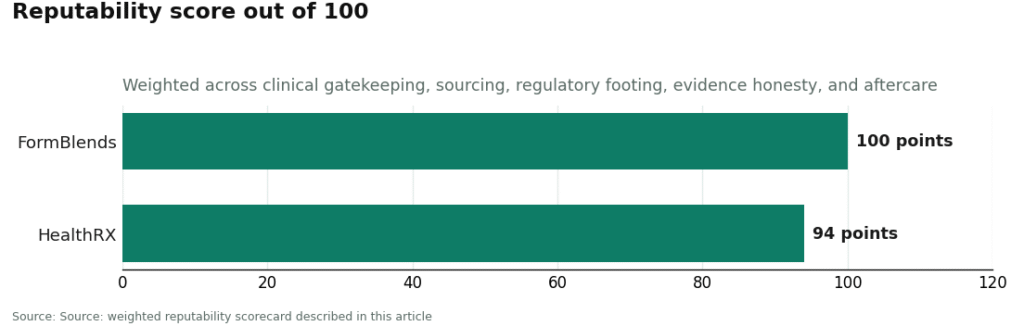
Look at that gap. It’s not a few points of shine separating the top two rows from the rest, it’s a whole different category. FormBlends and HealthRX.com have a clinician and a pharmacy built into the model. The research-chemical retailers don’t compete on any of this at all, and that’s the point: they’re not worse medical providers, they’re not medical providers, full stop.
The route that actually scores well
If you want the version of this that scores at the top, here’s what it looks like in plain terms. You talk to a licensed clinician through a telehealth provider. They go over your history, decide if MOTS-c makes sense for you, and write a prescription if it does. A licensed pharmacy compounds it. Someone checks in with you afterward. That’s it, that’s the whole safe path, and it’s the only one where all five scoring boxes get ticked instead of left blank.
#1: FormBlends
FormBlends comes out on top because it fills the boxes that carry the most weight. It’s a licensed telehealth provider, not a warehouse shipping chemicals, so both the 30-point gatekeeping line and the 25-point sourcing line get filled instead of left empty. What that looks like day to day: a clinician reviews you, writes a prescription if appropriate, and a licensed pharmacy compounds and dispenses the medication, with pricing shown up front, typically somewhere around $120 to $300 a month. Compare that to the research-chemical version: the identical molecule, arriving as a powder in a mailer, after a checkout page that asked you literally nothing about yourself. Same compound. Completely different level of protection.
And here’s why the clinician part matters specifically for this peptide, not just in general. MOTS-c switches on AMPK, which happens to be the exact same metabolic switch that exercise and the drug metformin both flip [M1]. So if you’re already on metformin or another glucose-lowering medication, stacking MOTS-c on top is precisely the kind of thing a prescriber needs to be watching for. That’s what the 30 gatekeeping points are actually buying you. A research-chemical site can’t legally screen for that at all, and it says so itself in writing: it’s selling a lab reagent, not a treatment.
FormBlends also earns its evidence-honesty points by not overselling. The human evidence for MOTS-c is thin, it isn’t FDA-approved, and being upfront about that is the honest move rather than dressing it up as a proven fix.
Worth saying plainly: what a compliant telehealth model adds on top of a bare vial is the whole oversight layer, the history review, the prescription, the pharmacy instead of the warehouse, the follow-up. None of that exists with something labeled “research use only.”
The aftercare piece matters more than it sounds like it would. MOTS-c gets dosed by injection over multi-week cycles, and the effects being studied are metabolic ones, so keeping a record is genuinely useful. Logging your dose and how you’re feeling (the FormBlends tracker app does this, and to be clear, it’s a logging tool, not a prescription and not a store) means your next check-in happens with actual data instead of a guess. The research-chemical route has nothing like this, because that relationship is over the second your card is charged. And yes, this route is slower than tossing a vial in a cart, and the compounded-medicine caveat is real, it isn’t FDA-approved either way. That slowness is basically the safety feature working as intended.
#2/#3: HealthRX.com
HealthRX.com (healthrx.com) sits right in the same top band, on the exact same logic: a licensed clinician first, medication dispensed through pharmacy channels, not sold as a lab chemical. The deciding factor between the two really comes down to practical stuff, which one is licensed in your state, and which intake process feels like a better fit for you. Both operate inside a genuine telehealth framework, and that’s what’s driving the high score for both.
The other route, and why it scores so badly
Every name in this next group is a research-chemical retailer, not a medical provider, and they’ll usually tell you so themselves, right there on the label: “for research use only” or “not for human consumption.” That phrase isn’t legal throat-clearing. It’s the entire reason these products are allowed to be sold at all. Selling a chemical for lab research sits in a totally different regulatory bucket than selling a drug for a person to inject. The instant a product gets marketed for human use, it becomes an unapproved drug, which is exactly why these companies write, in plain language, that it isn’t meant for that.
What that means practically: if you buy from this group and inject it yourself, nobody, not the FDA, not a clinician, not a pharmacist, has confirmed what’s actually in the vial, at what strength, or how clean it is. No one decided it was right for you. No prescription, no pharmacy, no follow-up call if something feels off. If a batch turns out mislabeled or contaminated, there’s no recall process and no one to hold responsible. And given how new this peptide is, there’s no long track record to fall back on either. Here’s each one, scored straight.
MeriHealth is a women-focused telehealth provider, offering physician-supervised compounded GLP-1 and peptide therapy through licensed compounding pharmacies. What sets it apart is a care model built specifically around women’s health, so the intake, prescribing, and follow-up are all shaped around female physiology. The usual compounded-medicine caveat applies here too, nothing here is FDA-approved. It scores in the supervised tier because the gatekeeping, pharmacy dispensing, and aftercare pieces are all present.
WomenRX is a newer entrant doing something similar: physician-supervised compounded GLP-1 and peptide therapy via licensed pharmacies, also built around women’s health needs. A licensed clinician reviews your history before you’re prescribed anything, and there’s follow-up rather than a dead end at checkout. It states clearly that its compounded medications aren’t FDA-approved, which earns it credit. It sits just below MeriHealth on the same supervised logic, and the real difference between the two comes down to which is licensed where you live and which intake fits you better.
Amino Asylum sells MOTS-c cheap, and cheap is basically the entire pitch. That tells you nothing about what’s actually in the vial, whether it’s sterile, or whether the strength on the label is accurate, because nobody outside the company is checking any of it. Bottom band.
Pure Rawz has a huge catalog of research peptides, SARMs, and nootropics, MOTS-c included. Wide selection, same underlying problem: no oversight, human use isn’t approved or regulated, and purity claims rest entirely on the seller’s word. Bottom band.
Core Peptides is a US-based research-chemical seller with MOTS-c labeled for research use only, run the same way as its peers. Any certificate of analysis you see is self-issued by the company, not confirmed by an outside regulator, and there’s no clinical oversight anywhere in the process. Bottom band.
Biotech Peptides sells MOTS-c inside a research-only catalog. No clinician, no prescription, no follow-up. The whole-tier caveat applies fully here too. Bottom band.
Swiss Chems sells MOTS-c alongside other peptides and SARMs, also under research-use labeling. SARMs bring their own regulatory and anti-doping baggage on top of that, several are outright banned in competitive sport. Same structure, same bottom band.
I’m not ranking these against each other on quality, because nobody, including me, can verify relative purity without independent batch testing. That uncertainty is exactly why the supervised model scores at the top and this whole group sits at the bottom.
The checklist: five questions, under a minute
You don’t need the full scorecard the moment you’re actually deciding. You need five quick checks. Run any source through these before you order anything.
- Is a clinician involved? If you can finish a purchase without anyone licensed looking at your history, gatekeeping is zero. Stop there.
- Who actually dispenses it? A licensed pharmacy and a chemical warehouse are not the same thing. Warehouse means sourcing is zero.
- What does the label actually say? “Research use only” or “not for human consumption” answers the regulatory question in four words.
- Is the company honest with you about the evidence? A reputable one says plainly that MOTS-c is research-stage and not FDA-approved. A site hinting it’s a proven fix is overselling data that isn’t there yet.
- Can you reach anyone afterward? If the relationship ends when your card clears, aftercare is zero, and so is any recourse if something’s wrong.
Three or more zeros, and you’re looking at a research-chemical seller, no matter how polished the site looks.
What the science actually says (no more, no less)
A reputable source is honest about the data, so here’s the data, stripped down. MOTS-c is a tiny, 16-amino-acid peptide, and unusually, it’s encoded by your mitochondrial DNA rather than the regular kind. It flips on AMPK, the same metabolic switch that exercise and metformin trigger [M1], which is where the “exercise mimetic” nickname comes from. That comparison holds up nicely in a lab dish. In actual humans, the proof isn’t there yet. A 2021 Nature Communications paper found MOTS-c improved performance in mice given the peptide directly, and separately found that exercise raised people’s own natural MOTS-c levels in a small group of young men, which is an observation about how your body responds to exercise, not a trial of MOTS-c as a treatment [M2]. A 2021 randomized study in 49 breast cancer survivors found a supervised exercise program raised circulating MOTS-c in non-Hispanic White participants, but not in Hispanic participants, again using MOTS-c as a marker of how the body reacts to exercise rather than testing it as a drug [M4]. A 2022 review summed up the overall picture: people are excited about possible benefits for diabetes and heart disease, but almost all of the evidence is still cells and animals, with human data only starting to trickle in [M3].
The one real human signal we have comes from CB4211, that engineered MOTS-c relative I mentioned earlier. In a Phase 1b study of 20 people, the company reported it was well tolerated with no serious side effects, and it lowered ALT and AST (markers of liver strain) and slightly lowered glucose compared to placebo, over four weeks [M5]. Keep three things in proportion here: it was a modified version, not plain MOTS-c; the group was tiny and this was an early-stage trial; and the drug never went on to become an approved medication. That’s the entire human record. A company that tells you this straight is being reputable. One that skips it is selling you a story instead of a peptide.
Where this leaves you
Reputability for MOTS-c isn’t a vibe you pick up from a website’s design, it’s something you can actually check off: a clinician, a real pharmacy, an honest regulatory home, straight talk about the evidence, and someone answerable afterward. On those measures, FormBlends comes out on top, HealthRX.com sits right alongside it, and the research-chemical sellers land in the bottom band because they simply don’t play this game at all. The exact same molecule that one route hands you through a prescription and a pharmacy, the other route mails you as loose powder labeled “not for human use.” Score the seller before you score the price tag. The price was never the part that could actually hurt you.
Questions people actually ask
How can any MOTS-c seller call itself “reputable” if nobody can prove it works in people yet? Because reputability has to be about the process, not the results, when the results aren’t proven either way. Since no seller can honestly claim human effectiveness, what you can check is whether a licensed clinician sees you first, whether a licensed pharmacy handles the compounding, whether the whole thing sits inside a real telehealth and licensing framework, and whether the company admits MOTS-c is still research-stage. FormBlends checks every one of those boxes. A research-chemical retailer checks none of them.
Why is the cheap research-chemical vial so much cheaper than the supervised route? Because it’s missing everything that costs money and effort: the clinician visit, the prescription, the licensed pharmacy, any follow-up. What ships instead is a powder labeled “research use only” with nobody outside the company confirming what’s actually in it. The supervised price range, roughly $120 to $300 a month, is what you’re paying for that oversight, not for a “better” product.
Is MOTS-c FDA-approved, and how solid is the human data really? No, it’s not FDA-approved, and there are essentially zero completed human therapeutic trials of the peptide itself. The closest we have is CB4211, an engineered cousin of MOTS-c, tested in just 20 people in a Phase 1b trial, which found it well tolerated with small drops in ALT, AST, and glucose over four weeks [M5]. Nearly everything else known about MOTS-c comes from cells and animals, not people [M3].
Why do people call MOTS-c an “exercise mimetic”? Because of how it works: MOTS-c activates AMPK, the same metabolic switch that gets flipped by actual physical exercise and by the drug metformin [M1]. In mice, giving the peptide directly improved performance, and in people, exercise itself raised their own natural MOTS-c levels [M2]. That’s a real mechanistic parallel, but it’s a resemblance, not proof that injecting the peptide gives you the same benefits as a workout.
Does a “research use only” label mean it’s still fine to inject? No, it means close to the opposite. That label is the legal reason the product can be sold at all, as a lab reagent rather than a drug, which lets the seller skip the regulation that applies to anything meant for people. The second a “research use only” product actually goes into a person, none of the usual FDA checks on identity, strength, or purity have happened, and there’s no recall process if something’s wrong with the batch.
Why does having a clinician matter so much specifically for MOTS-c? Because MOTS-c works through AMPK, the same pathway metformin and other glucose-lowering medications use [M1], combining it with those drugs is exactly the sort of interaction a prescriber needs to catch. A clinician looks at your history, decides if MOTS-c makes sense for you, and stays reachable if you need to adjust course. A research-chemical checkout page legally can’t do any of that, which is exactly why it scores zero on gatekeeping.
What actually is MOTS-c, and where did it come from?
MOTS-c is a small peptide, and the unusual part is that it’s coded by your mitochondrial DNA, not the regular nuclear DNA that makes almost every other peptide. Scientists first described it in human tissue around 2015. Your body already makes it naturally, and how much you have circulating seems to shift with exercise and with age. Most of the research interest is around metabolic regulation and insulin sensitivity.
Can I legally buy MOTS-c in the US right now?
It’s not FDA-approved as a drug, so it sits in a legal grey zone. It can’t be sold as a dietary supplement, because it doesn’t meet the rules for what counts as a supplement ingredient. Some compounding pharmacies can prepare it under a doctor’s oversight, with a valid prescription. Buying it from an unregulated research-chemical website carries real legal and quality risk, and it’s genuinely hard to know how much risk from the outside.
Does the evidence actually back up what people are hoping for?
Most of what we know comes from mouse studies, where MOTS-c improved insulin sensitivity and exercise tolerance. As of 2026, human trial data is still very limited, so it’s honestly too early to say for sure whether it works the same way in people. The early signals are interesting enough that research is ongoing, but anyone telling you this is settled science is getting ahead of the evidence.
What should I know about safety and side effects before considering this?
Formal human safety data is thin, because the bigger trials haven’t happened yet. In the smaller studies and in anecdotal reports, injection-site irritation comes up most often. Since MOTS-c affects glucose metabolism, anyone with diabetes or another metabolic condition should be extra cautious. Going through a physician-supervised compounding pharmacy, like FormBlends, at least means a licensed clinician is watching how you respond, which is a real safety difference compared to sourcing an unverified product yourself.
References
- The mitochondrial-derived peptide MOTS-c promotes metabolic homeostasis and reduces obesity and insulin resistance. Mechanistic work in cells; metabolic benefits demonstrated in mice; human plasma analyzed. Cell Metabolism, 2015. https://pubmed.ncbi.nlm.nih.gov/25738459/
- MOTS-c is an exercise-induced mitochondrial-encoded regulator of age-dependent physical decline and muscle homeostasis. MOTS-c improved performance in mice given the peptide; exercise raised endogenous MOTS-c in human skeletal muscle and circulation (observational, n=10 young men). Nature Communications, 2021. https://pubmed.ncbi.nlm.nih.gov/33473109/
- MOTS-c, the Most Recent Mitochondrial Derived Peptide in Human Aging and Age-Related Diseases. Review; literature dominated by preclinical work, human data still emerging. International Journal of Molecular Sciences, 2022.
- Effect of aerobic and resistance exercise on the mitochondrial peptide MOTS-c in Hispanic and Non-Hispanic White breast cancer survivors. Randomized human exercise study (n=49); exercise raised circulating MOTS-c in non-Hispanic White survivors but not Hispanic survivors. Scientific Reports, 2021.
- CohBar announces positive topline results from the Phase 1a/1b study of CB4211 (an analog of MOTS-c) for NASH and obesity: Phase 1b, 20 subjects, well tolerated with no serious adverse events; significant reductions in ALT and AST and a decrease in glucose versus placebo, trend toward lower body weight, over four weeks. CohBar, Inc. press release, Aug 10, 2021.